1
/
of
1
store-traders-com
Stocks & Commodities V. 28:5 (12-24): Debit or Credit? by Giorgos E. Siligardos
Stocks & Commodities V. 28:5 (12-24): Debit or Credit? by Giorgos E. Siligardos
Regular price
$5.95 USD
Regular price
Sale price
$5.95 USD
Quantity
Couldn't load pickup availability
Debit or Credit? by Giorgos E. Siligardos
That is the question. If you are confused about which vertical spread to use, find out here.
Are vertical credit spreads better than their counterpart debit spreads? In this article I will discuss their main and subtle differences (and similarities) with an emphasis on the income-generating strategies. Now that trading direct derivatives is open to retail traders, both experienced professionals and novices engage in complex option positions like spreads, butterflies, condors, and so on. Among these advanced positions, the vertical spreads (referred to as verticals) are the most popular because of their relative simplicity, their definition of clear profit & loss levels, and their use as income-generating strategies. I will first give a short but solid overview of the basics of verticals and the problems they intend to solve. In the sequence I will contrast the debit verticals with the credit ones and attempt to offer a complete answer to the debits or credits? question.
BASIC DEFINITIONS
Lets start with two basic definitions:
- A vertical with calls is a composite position that consists of a long position in a call with strike price X and a short position in a (cheaper) call of the same series with higher strike price Y.
- A vertical with puts is a composite position that consists of a short position in a put with strike price X and a long position in a (more expensive) put of the same series with higher strike price Y.
When you buy the vertical with calls (long position in the vertical with calls), you buy the low strike call and sell the high strike call. When you sell the vertical with calls (short position in the vertical with calls), you do the opposite: you sell the low strike call and buy the high strike call. By the same token, when you buy the vertical with puts (long position in the vertical with puts), you sell the low strike put and buy the high strike put and when you sell the vertical with puts (short position in the vertical with puts), you buy the low strike put and sell the high strike put.
You may wonder about how appropriate the terms buy and sell are, since each vertical is a composition of a long position and a short position, but these terms can be used because eventually a position in a vertical (just like the basic positions in calls and puts) is built either by giving money (hence the term buy or long) or by getting money (hence the term sell or short).
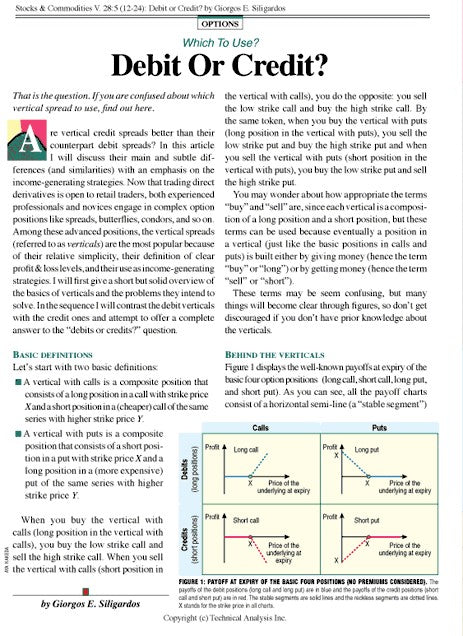
These terms may be seem confusing, but many things will become clear through figures, so dont get discouraged if you dont have prior knowledge about the verticals.
That is the question. If you are confused about which vertical spread to use, find out here.
Are vertical credit spreads better than their counterpart debit spreads? In this article I will discuss their main and subtle differences (and similarities) with an emphasis on the income-generating strategies. Now that trading direct derivatives is open to retail traders, both experienced professionals and novices engage in complex option positions like spreads, butterflies, condors, and so on. Among these advanced positions, the vertical spreads (referred to as verticals) are the most popular because of their relative simplicity, their definition of clear profit & loss levels, and their use as income-generating strategies. I will first give a short but solid overview of the basics of verticals and the problems they intend to solve. In the sequence I will contrast the debit verticals with the credit ones and attempt to offer a complete answer to the debits or credits? question.
BASIC DEFINITIONS
Lets start with two basic definitions:
- A vertical with calls is a composite position that consists of a long position in a call with strike price X and a short position in a (cheaper) call of the same series with higher strike price Y.
- A vertical with puts is a composite position that consists of a short position in a put with strike price X and a long position in a (more expensive) put of the same series with higher strike price Y.
When you buy the vertical with calls (long position in the vertical with calls), you buy the low strike call and sell the high strike call. When you sell the vertical with calls (short position in the vertical with calls), you do the opposite: you sell the low strike call and buy the high strike call. By the same token, when you buy the vertical with puts (long position in the vertical with puts), you sell the low strike put and buy the high strike put and when you sell the vertical with puts (short position in the vertical with puts), you buy the low strike put and sell the high strike put.
You may wonder about how appropriate the terms buy and sell are, since each vertical is a composition of a long position and a short position, but these terms can be used because eventually a position in a vertical (just like the basic positions in calls and puts) is built either by giving money (hence the term buy or long) or by getting money (hence the term sell or short).
These terms may be seem confusing, but many things will become clear through figures, so dont get discouraged if you dont have prior knowledge about the verticals.
Share